
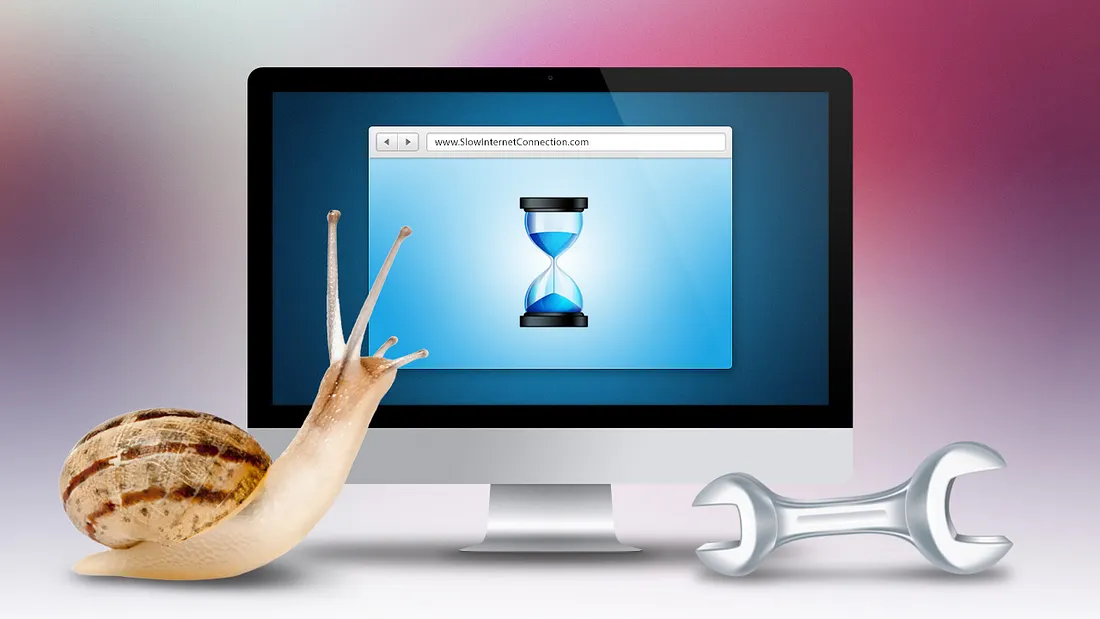
My internet connection is so slow it gives you time to think, analyze, reflect, have some coffee, and even plan your next chess move, your vacation plans, or simply ponder the meaning of life beyond death, all while waiting for Gmail to load. I could include a screenshot of a Speedtest, but their website doesn't even load.
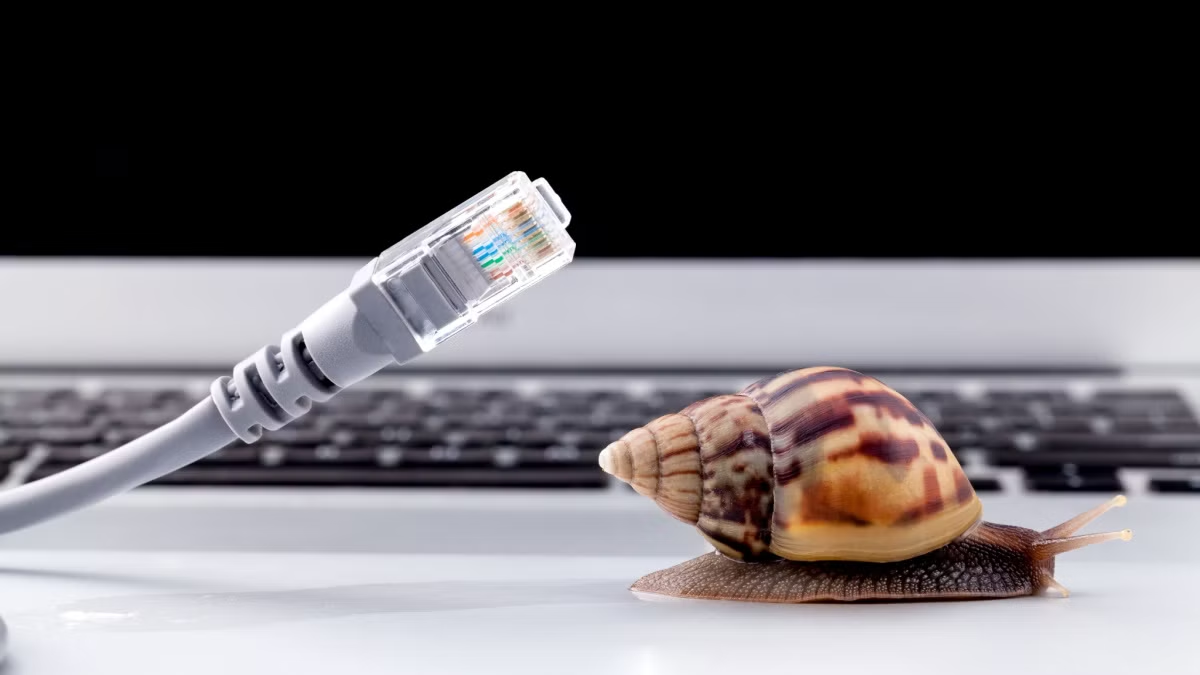
Living with the worst internet connection in the world, the official title that Venezuela gloriously holds, is no easy feat, even when you're surviving in a country that, if not the leader, is in the top ranks of almost every negative aspect of a society (I'll break those down later). During that eternal wait for an email to open, a webpage to load, or an Instagram image to render, I thought about recording a video of how slow and tedious it is to deal with this ABA connection, but then I figured no one would watch it, precisely because it would be so boring. Maybe it would only be interesting to Venezuelans abroad, and it would only serve to dispel their doubts whenever nostalgia hits and the idea of returning crosses their minds, even if they're kilometers (or miles, depending on where they emigrated to) away. A video like that would be enough to dissuade even the most nostalgic and sentimental among them.
And no, it's not trivial to complain about internet connectivity in the most violent country in the world, with the highest inflation in the world, fighting a cancer called socialism, and whose society, like an immune system, struggles to expel from its body an evil that turned the country with the largest oil reserves in the world into one with a worse per capita income than Haiti, the poorest country in the Americas. In Haiti, the minimum wage is 5 dollars a day; in Venezuela, it's 5 cents of a dollar. If you're poorer than the poorest, what does that make you?
And I say it's not trivial because education and access to technology are the highways of progress, especially for countries that want to escape poverty. A society with poor education (check the WEF education quality ranking from bottom to top and you'll find Venezuela behind several African countries, among the last in the world) and without access to cutting-edge technology will find it nothing short of a miracle to break the cycles of poverty and ignorance (or ignorance and poverty, it's unclear which comes first) that characterize 3rd and 4th world countries, because if Venezuela isn't already in the 4th world, what we're living through looks exactly like it. We were in the 3rd world 20 years ago, when textbooks described Venezuela as a developing 3rd world country; today we're not even on the path to destruction anymore, because we've already traveled that road. And although things can always get worse, we're closer to the end of the tunnel, the beginning of nothingness.
Making access to decent technology difficult, in a country where a middle-class citizen can't afford to buy a computer due to its exorbitant price, where it's also impossible to import a device from abroad due to strict currency controls, with connection speeds of barely 1MB (if you're lucky, and when it's even available, the rest of the time it's just a few Kbps), condemns new generations to remain trapped in a cycle of ignorance, loss of competitiveness, poverty, and dependence on State aid—that same State that steals 7 out of every 10 dollars that enter the country (figures from Transparency International) and that openly automates, issues ID cards, mobilizes, and blackmails those who receive State aid into voting for them, under threat of losing those scarce benefits if they don't support them. There are hundreds of videos on Youtube showing this, if you want to find specific examples. That kind of State will hardly want educated and informed people, people with solid moral values, people who don't depend economically on State aid and who have critical thinking skills—in short, people who can't be "convinced" with a bag of low-quality food or the promise of an apartment in a poorly built housing block in a high-crime area.
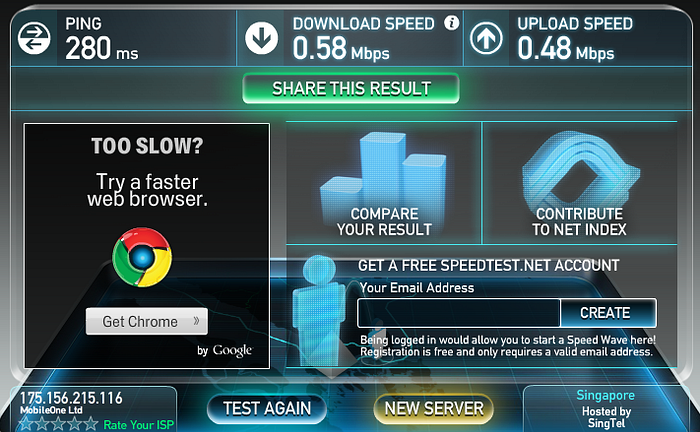
It's not that us geeks can't watch Netflix movies in HD, it's that we can't open an email quickly, nor load a site at an acceptable speed, we can't make a Skype call, not even using voice only, without it dropping. We can't participate in webinars, nor do a video conference, nor a video call, nor stream live events, we can't even upload a 1-minute video to Twitter of something we recorded. I also can't, as a university professor, teach a live class, because the speeds make it impossible—there's no service that can work at such reduced speeds. In fact, when trying to publish this post, it will probably take me half an hour or more, with several timeout messages included. This results in a loss of global competitiveness for our professionals, who, aside from being unable to develop new technical skills, are unable to compete in a world that keeps moving forward, while we are, at best, stuck in time—20 years behind, to be more specific. You can't be competitive when something others do in seconds takes you several hours. Multiply that by hundreds of tasks in a day, and the delay isn't measured in hours, it's years of lost time.
The saddest part of this story is that this slowness isn't just due to lack of investment (though there is a lack), technical incapacity (though there is that too), or ineptitude (though there's plenty of that), but rather it stems from a macro policy of digital isolation of society (more info here). An approach that turns out to be a mix of Chinese censorship, North Korean control, and obsolete Cuban telecommunications, and which is by no means the conclusion of a paranoid geek obsessed with a mediocre connection, but rather the result of a State policy openly stated in national plans, as you can see in the following image:
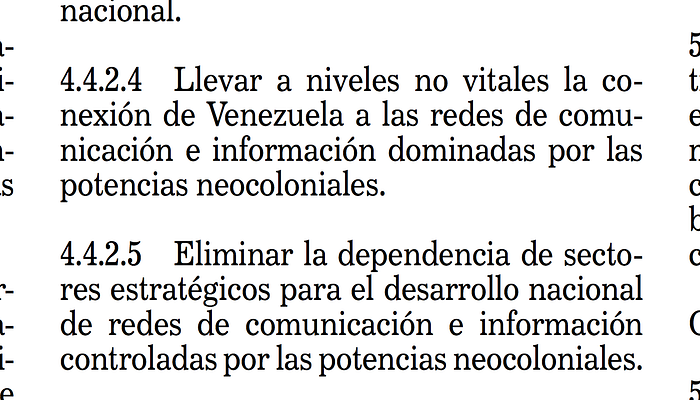
«Plan de la Patria 2013–2019»
After all, what kind of government wants a hyperconnected society, fully communicated with the rest of the world? The answer is obvious.
I'll leave you now, Gmail finally loaded.